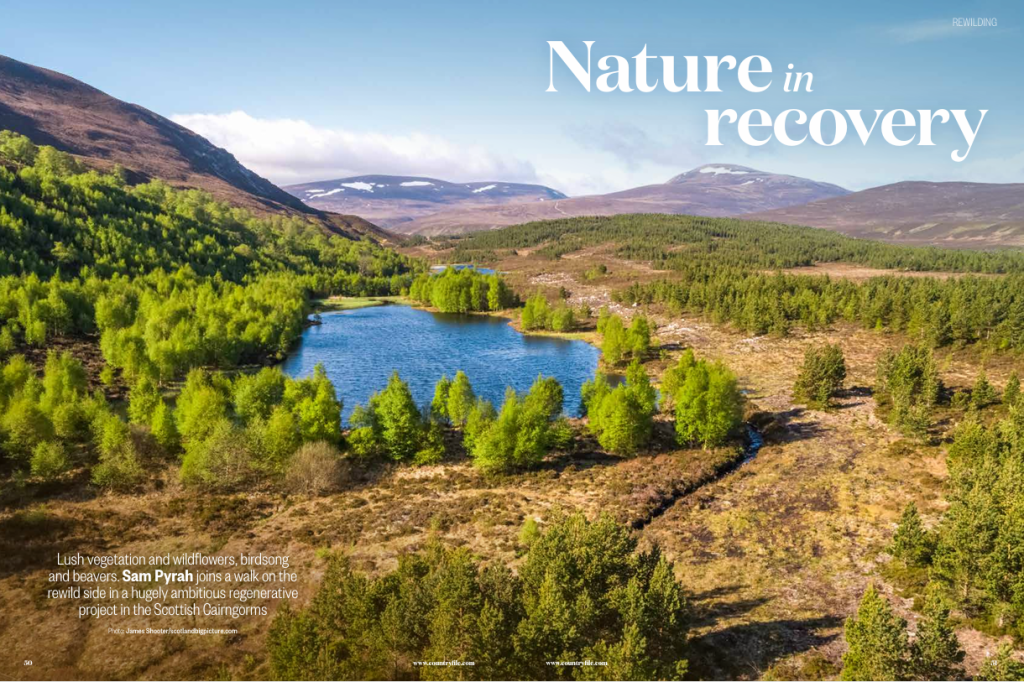
Rionnach maoim is a Gaelic phrase describing “shadows of cumulus clouds moving across moorland on a sunny, windy day”. It is just such a day today, as we leave the old ruins of Ruthven Barracks and climb south onto the moor-clad slopes of Beinn Bhuidhe. The vibrant purple flowers of bell heather throng with mountain bumblebees. The ling, a more muted shade of mauve, is just coming into bloom.
The sun is hot. We pause to catch our breath, and look back across the broad strath of the Spey. The bare, rugged domes of Creag Mhor and Creag Bheag rise up in the near ground, with the grey shapes of higher peaks beyond. There is a stark beauty to the scene – one that many regard as quintessentially Scottish – craggy, cropped, treeless. But the landscape through which we are walking is altogether different.
It is still moorland, but here, young trees dot the slopes – mostly rowan and birch, along with a few Scots pine. There are open grassy patches amid the heather, where wildflowers and the tufty white heads of cottongrass nod in the breeze. A large toad hunkers down on the path. Then, thrillingly, a hen harrier, brown – so, either female or juvenile – flies into view, quartering the ground before landing on a rock.
This is nature in recovery. When WildLand, a company specialising in ecological restoration, took on this land in 2014 it mirrored the denuded hills across the strath. A strict deer management policy was introduced to bring numbers under control. This reduction in grazing pressure, along with planting where appropriate, is what has given the trees, shrubs and flowers a chance to regenerate, bringing the landscape back to life.
The three Rs
Regeneration, restoration, recovery – all good words – and words that skirt diplomatically around the original R-word that has become so mired in controversy in the last decade – rewilding.
For some, rewilding simply means taking a step back to let nature recover. For others, it necessitates the reintroduction of missing species, like lynx, wild boar or wolves. Whatever the differences in opinion (and there are many) regarding the right approach, the common goal is nature recovery – “that leads to restored ecosystem health, function and completeness,” as national rewilding charity SCOTLAND: The Big Picture (SBP), puts it.
I’m taking part in one of SBP’s Rewilding Journeys, in the Cairngorms National Park.
“We developed our Rewilding Journeys as a way for eco-conscious travellers to learn first-hand about transformational rewilding initiatives, while experiencing landscapes of hope and enjoying fantastic Highland hospitality,” explains SBP’s Kathryn Morris. Two of my fellow participants can vouch for this – they’ve been before and are back for more.
This particular offering – ‘Walking the Wild’ – takes place mostly on foot. Think walking holiday meets study tour, complete with packed lunches, wild swimming and comfy beds.
Yesterday, our five-strong group visited two sites where beavers have been reintroduced and are busy reshaping the ecosystem, with dams and gnawed trees the telltale signs.
The day before, we explored Abernethy Forest, the largest remaining fragment of the ancient Caledonian pinewood that once covered swathes of Scotland. Some of the ‘granny pines’ there are 450 years old; their bark has thickened into rust-red plates, their trunks bulge and twist – a far cry from the uniform growth of a plantation forest.
Abernethy has been in the hands of the RSPB since the mid-1980s. A lauded conservation body in its own right, the RSPB is also one of four partners – alongside WildLand, NatureScot and Forestry and Land Scotland – that united in 2016 to form the visionary Cairngorms Connect project. Its aim is habitat restoration across a landscape that extends to 600 square kilometres – including native forest, wetland and rivers, peatland and montane ecosystems – over a timescale of 200 years.
Addressing the deer problem
Again, deer management lies at the heart of the project. When I’d heard the phrase before, I assumed it was a euphemism for culling. “Getting numbers down to a healthy level is a big part of management, but it’s also about keeping the deer moving,” says Jack Ward, our trip guide, and one of 15 highly trained deer stalkers utilised by Cairngorms Connect. “When there are no predators to fear, deer tend to stay in one area for too long, completely stripping it of young trees,” he explains. “If they are aware that there is potential danger, they’ll keep on the move, browsing and pruning but not decimating vegetation.” This allows the forest to regenerate.
Some people are uncomfortable with the idea of culling deer – red and roe deer are both native species. Aren’t they part of the ecosystem? “They are, and we want them here,” insists Ward. “A little bit of grazing pressure is good for the landscape.” He shows us a deer-nibbled rowan sapling, pointing out how the bitten area has thickened in response to attack. “But it’s about having the right numbers.”
Scotland’s deer population is widely regarded as problematic. It’s grown too big for two main reasons: the absence of predators – animals that were once part of the Scottish landscape, like lynx and wolves – and the preference of traditional sporting estates to favour high numbers of deer for shooting. A NatureScot report in 2020 estimated the population of red deer on open ground (as opposed to forest) in the Highlands to be 40% higher than it was in 1990, which in turn, is estimated to be five times higher than in the 1950s. “Too many deer isn’t just bad for the environment, it’s bad for the deer themselves,” says Ward. “In harsh winters, when food is scarce, many starve to death in overpopulated areas.”
The deer that are culled within the Cairngorms Connect partnership area benefit the local community through the Venison Project, which aims to promote venison as a healthy, sustainable meat and make it available to local people at affordable rates. The ‘gralloch’ (the entrails) is left on the hill, where its nutrients benefit wildlife and soil.
Back on the hill, a second hen harrier joins the first.
“Definitely juveniles,” says Ward, from behind his binoculars. “That’s brilliant, it means a pair have bred successfully.” He takes down the grid reference to pass on to the WildLand team.
Walking with someone so keen-eyed and knowledgeable is like viewing your surroundings through a new lens. In Abernethy Forest, Ward picked up a large feather – mostly brown, long and surprisingly stiff. A minute later, we’d had a crash course in bird anatomy, and knew not only what bird it was from – a female capercaillie – but why it was there (the birds were in moult), from which part of the bird it came (a primary wing feather) and even which wing (right).
We pass over the shoulder of Ben Bhuidhe and descend through chest-high bracken and dappled birchwood into Glen Tromie. Picking up the river (where another restoration project, involving ‘rewiggling’ a straightened channel and slowing the flow rate by laying trees on the riverbed, is underway) we follow a parallel course through the glen. The scene feels almost make-believe – lush green vegetation and wildflowers, alive with birdsong and butterflies. The feeling only grows when Ward diverts us along a heathery trod to a rocky outcrop overlooking the boulder-strewn river. I slide into the cold black water with a gasp and float on my back, grinning up at my tour mates eating their sandwiches.
Ward regards the ecological restoration of these landscapes as a win-win – good for nature, good for us. But not everyone would agree. There is tangible opposition to rewilding – locally and nationally – particularly from some farmers, who see it as a threat to their traditional way of life and warn that it will negatively impact the UK’s food security.
For Robert MacDonald, chair of the Cairngorms Farmers and Crofters Community, species reintroductions, and other aspects of rewilding, such as the expansion of native woodland, risk driving people off the land.
While proponents of rewilding ponder keystone species and apex predators, the species that most concerns Peter Cairns, former CEO of SBP and host of At The Edge, a podcast examining our relationship with wild nature is… us. “Rewilding is 20% ecological, 80% psychological,” he says.
A mindset shift
It was 30 years ago when Cairns, who took on Ballintean, a 50-hectare former equestrian centre in stunning Glen Feshie that now serves as the base for SBP’s rewilding journeys. “It had been grazed by 52 horses, not to mention herds of red deer,” he tells us. “We sought advice about how best to rejuvenate the land, but everyone had a different theory, a different agenda. Although rewilding wasn’t a ‘thing’ back then, our instinct was that nature knew best and we sat back to see what happened.”
Three decades on, the results of this ‘hands off’ approach are clear to see. What had once been featureless, overgrazed fields is now reminiscent of a savannah, with scattered trees, scrub, grasses, mosses and wildflowers. A small herd of Highland cattle wander through, grazing, trampling and fertilising the land as they go.
Ballintean sits within the floodplain of the River Feshie, an 18-mile tributary of the Spey. In the winter of 2024, a big storm transformed the Feshie into a raging torrent, undercutting its banks, sending trees tumbling into the water and creating new channels and islands. “Look how much land you’ve lost!” people remarked to Cairns, lamenting the ‘mess’ the storm had left in its wake.
He has a different perspective. “We have become so conditioned to seeing landscape as passive and controllable,” he explains. “There’s a great resistance to anything that threatens to change the way we think things ‘should’ be. But we are going to have to accept change if we are to reverse nature loss across Scotland. We need to stop trying to dominate.”
Ballintean is part of the Northwoods Rewilding Network, SBP’s 100+-strong chain of 100-1000-acre landholdings across Scotland, which are rewilding according to an agreed set of principles. Individually, some of the projects may be small, but collectively they are helping to heal and join up fragmented landscapes. And perhaps even more importantly, they help normalise rewilding and showcase what benefits it can bring.
That’s important, because away from the regenerating landscapes we’ve been exploring these last few days, vast tracts of Scotland remain woefully nature depleted. In a 2023 report, Scotland was rated 212th out of 242 countries in terms of nature depletion, with 11% of its 7,508 species threatened by extinction.
On our final night at Ballintean, I walk down to the Feshie, take off my shoes and paddle in the cool, quiet water while the sunset drenches the sky orange and pink. I think back to Peter Cairns’ words, spoken at this very spot a few days earlier; how so much more of the landscape could thrive like this if we would only loosen our grip. “It’s our imaginations that need rewilding,” he’d said. I walk back, carrying my shoes.
REWILDING JOURNEY
The next Scotland: The Big Picture Cairngorms Rewilding Journey is scheduled for 25–30 April 2026 (there are further dates in May, Sept and Oct). The trip includes guided excursions each day, five nights’ accommodation at Ballintean Mountain Lodge with breakfast and dinner on site and lunch on the move. The cost is £1,895 per person. scotlandbigpicture.com
BBC Countryfile April 2026