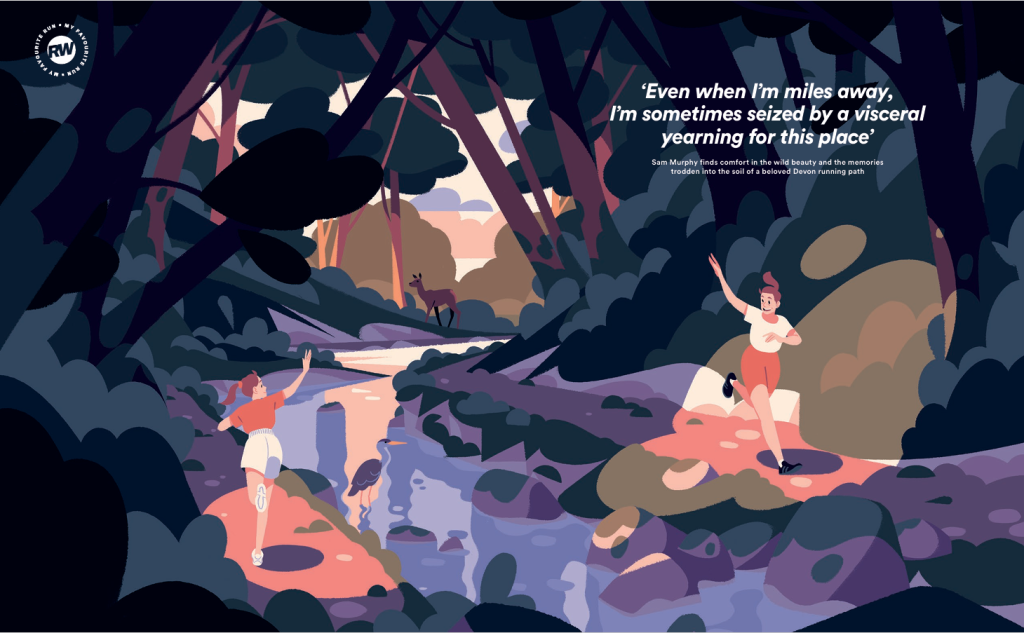
The ‘flat bits’ of this run are never as flat as I remember them. It’s the notion of a river valley that fools me every time; my brain conjures up an idyllic image of an amble along the water’s edge, with only the mildest of undulations. But this trail is far from what I conjure up. It starts out innocently enough, hugging the left bank of the East Lyn out of Lynmouth, past grand old Victorian villas and pastel-painted cottages, and on through sun-dappled broadleaf woodland. But soon the valley walls loom and narrow, sending the path – and my heart rate – up, up and away onto steep, wooded slopes, where trees heavy with ivy and lichen hang on grimly above the roaring river. Looking down, it’s not hard to imagine the might and pace of the water, swollen with flood debris, that raced down the gorge into Lynmouth one stormy night in 1952, sweeping 34 people to their deaths. No sooner have I reached the top of the tree line, caught my breath and gained a glimpse of the broccoli-crown forest beyond, than I am losing height again, plunged down to river level on a skinny path riddled with slippery rocks and trippy tree roots. How could I forget this?
The first time I ran this route, I’d slipped out of my hotel bed early and made my way onto a deserted village street, drawn by the fairy-tale wooded river valley we’d strolled through the day before. From the dinky harbour, where the East Lyn flows into the Bristol Channel, I headed upriver. My Londoner’s feet were more accustomed to asphalt than trail, my thighs honed for city pavements, not punishing gradients, but it thrilled me to be running through this Hobbit-world landscape. I felt quite the adventurer by the time I reached an old stone bridge, raised like an eyebrow over the river, and crossed for the return leg, anxious not to miss breakfast and blissfully unaware that I’d barely covered three miles.
Five years later, my jaunts in the Lyn Valley started not from a hotel room but from my own front door. I moved here, smitten by the scenery (as were William Wordsworth and Percy Shelley in their day; not bad company).
As I became more adept at offroad running, I ventured further along the valley – to Watersmeet House, a grand old 19th-century fishing lodge-cum-tearoom, where I sometimes rewarded myself with a slice of cherry pie – and on through the hamlets of Rockford and Brendon. Then further still – up to County Gate, where Devon ends and Somerset begins, or across to Countisbury, where the high plateau of Exmoor teeters on the edge of coastal cliffs. I could clock up 10, 15, 18 miles – and thousands of feet of climb – on these runs. But I always remembered, when I passed that stone bridge, how it had once felt such a challenge.
The river seems in a great hurry to reach the open sea today. It rushes and tumbles over its rock-littered bed and swerves around mossy boulders, upon which dippers bob and flit, like expert canoeists. I, on the other hand, am taking my time. I want to let the memories of the miles, trodden into this soil over more than two decades, surface at their own pace. And besides, even now this isn’t a run with easy pickings – relentless ups and downs, vegetation closing in on the path, fallen branches, puddles and slick rocks underfoot. I pass the spot where, to my utter disbelief, I saw a salmon leap from the foaming river. And here’s where I first encountered wild Exmoor ponies, and scarpered in alarm when one made a beeline for me. Ah, these are the wooden steps I tripped on, and sat sobbing while my fox terrier, Sid, looked on, his head tilted quizzically.
It’s not just the runs that come flooding back, but the runner, too. My younger self; filled with confidence and clarity one minute, heartbroken and hungover the next; bold and fearful in equal measures, more mindful of my failures and regrets than of my successes. And often lost. I wish I could tell her it was all going to be OK. But at least she had running – and this place – to help her find a way through.
Even when I’m miles away – and I usually am, since I no longer live here – I’m sometimes seized by a visceral yearning for this place. In my memory, it’s never baking hot nor freezing cold in the valley. It’s mild, or crisp, the sky a perpetual Wedgewood blue, the vegetation damp and lush, as if the river itself is bubbling up from the earth or seeping through its moss-shrouded rocky banks. In spring, giant ferns grow impossibly green, like plastic ones on a cafe table; wild garlic carpets the forest floor and tickles your nostrils.
But it’s late October now. The bracken is rusting into a palette of metallic browns and yellows. I catch a whiff of the earthy scent of decay when I breathe in. I’m upriver from Watersmeet, where the valley walls have relaxed their grip on the river, allowing calmer shallows and pools to form. You sometimes see herons poised in the shadows. Now, my footsteps are deadened not by the roar of the river, but by the leafy mulch underfoot. The path levels out, opening on to gentle wooded slopes where shafts of light gleam through trees bedecked in startling shades of amber, russet and mustard. When the wind blows, it sends handfuls of them spiralling into the air. It’s time to turn back, because I want to leave time to climb up to Trilly Ridge, from where you can see for miles.
From Watersmeet, I make my way up a path lined with scrawny oaks, all seeming to crane their necks in the same direction. They are called sessile oaks, which I always assumed referred to their size and sculpted trunks; but it turns out that this is the work of the wind, and ‘sessile’ simply means that their acorns don’t have stalks, attaching directly to the twigs instead. When it gets steep enough to merit steps being cut into the path (this is where I had my fall), I give up trying to run and adopt the fell-runner’s walk, hands pushing against thighs to straighten my knees, letting my arms take some of the work out of the climb. At the top, the trees scatter and a grassy path trodden through the bracken opens out into a clearing where, long ago, I came face to face with a red deer for the first time. I press on, still climbing, albeit more gently, until I reach my favoured grassy knoll at Trilly. I look out onto an expanse of thickly forested hills bisected by plunging valleys – and beyond, to the muted rust and mauve carpet of Exmoor and the smudged grey-blue line between sky and sea.
There are still places on the moor where you can stand and turn 360 degrees and see no sign of human habitation. It’s a wildness and remoteness in which I find great comfort. But I can’t linger too long today – not if I want a slice of cherry pie before I head back to Lynmouth.
Runner’s World, June 2020