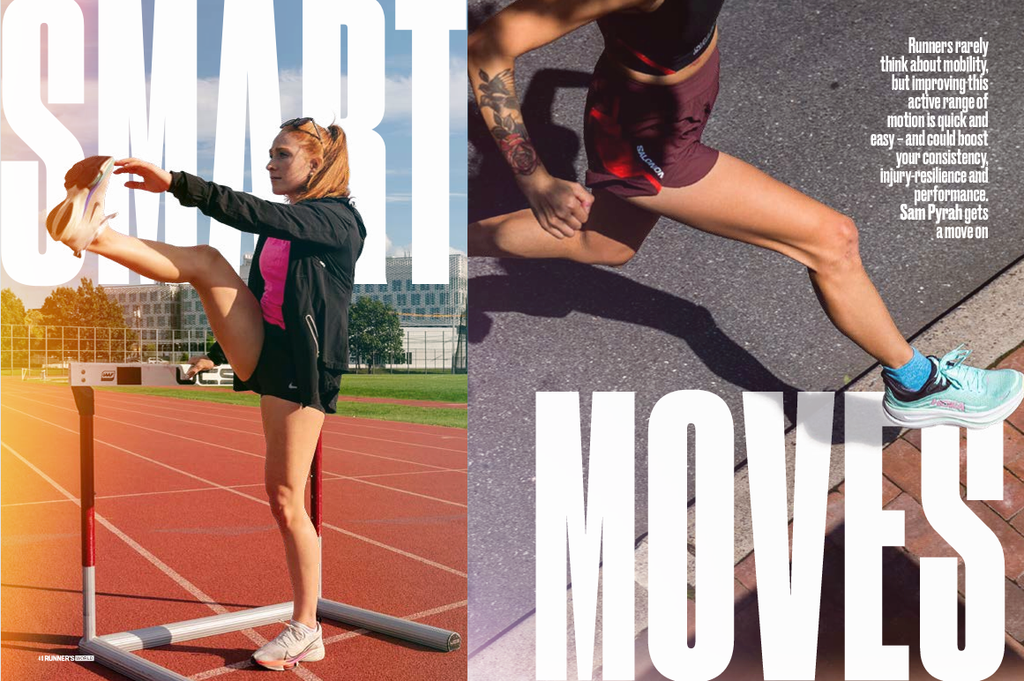
It all started last summer, when I came across my husband – a lifelong runner – performing some outlandish moves in the garden. ‘What are you up to?’ I asked. ‘Duck walking,’ he told me. I watched for a moment as, bent low in a full squat with heels raised, he waddled across the lawn, then set off on my run. Later, he explained that he’d been dabbling with some mobility exercises he’d come across on social media, and had been intrigued enough to buy the full online programme.
It didn’t take long for my curiosity to get the better of me. Soon, the pair of us were doing 15 minutes of mobility work, four to five times a week. A few months on, it feels as though parts of my body have woken up after years of slumber. When I run these days, my whole body participates. I’m not just a pair of lungs on legs.
And I’m not alone. For Uju Eze, a soft tissue therapist and keen runner, mobility training is a key part of staying consistent and injury-resilient. ‘Since
adding regular mobility work into my routine, I’ve noticed I move better, recover quicker and small niggles don’t hang around the way they used to,’ she says. ‘My running feels smoother and much more fluid.’
Before we extol the virtues of mobility training any further, it’s important to define what mobility is and, more importantly, what it isn’t. If you think you’re already ‘doing’ mobility because you stretch after your runs, you are confusing mobility with flexibility. Understandable, given that the terms are often used interchangeably; it’s not unusual to see a sequence of static stretches described as a ‘mobility’ workout.
‘Although flexibility and mobility are related, they are different concepts,’ explains Lauren Skopal, exercise and sport scientist and founder of Limber Sports Performance. ‘A simple way to think about it is that flexibility relates to passive range of motion – which is typically improved through static stretching – while mobility relates to active range of motion.’ As tight or shortened muscles can limit joint movement, stretching can aid mobility by increasing available range, but it’s only part of the picture. ‘To translate flexibility into usable movement, you need to be able to maintain dynamic control throughout the range of motion,’ says Skopal. This is where mobility-focused training comes in. As a runner, you’re most likely to have encountered mobility exercises within a warm-up. For example, leg swings or lunges with torso rotation, but as Skopal says, ‘the scope of mobility training extends beyond just warming up to maintaining or developing range of motion and refining motor patterns’.
A recent study from the University of Hildesheim in Germany sought to find out whether a mobility training intervention could alter tissue stiffness and joint range of motion in physically active adults. Over 12 weeks, the training group performed a 30-minute sequence of mobility exercises three times a week, while a control group exercised on an elliptical trainer. Movements within the mobility workout varied from week to week and included split squats with torso rotation, hip circles, dynamic plank variations and a marching bridge. The researchers measured range of motion in 27 different regions, including spinal rotation, flexion, extension and side flexion, trunk flexion, hip flexion and extension, ankle mobility and heel-to-buttock distance, noting any left-right asymmetries. After 12 weeks, range had significantly improved in all 27 areas among the mobility group, compared with 16 areas in the control group. The mobility workouts were also more effective than the elliptical trainer in ironing out left-right imbalances – asymmetry in hip range of motion was lessened by the former and accentuated by the latter. Tissue stiffness (how much ‘give’ there is in a particular tissue) was also assessed in the study, using shear wave
elastography technology. Out of 22 body areas assessed, there were significant improvements in both muscle and connective tissue following the mobility training programme.
This study demonstrates that mobility training is effective in improving, uh, joint mobility. But it doesn’t tell us anything about performance. Skopal’s research, however, did look at the effect of mobility training methods in sporting populations. Her systematic review, published in the Journal of Sport of Sciences in 2024, concluded that mobility training could benefit many aspects of performance.
Will it make me faster?
Look, we get it. You just want to run. You don’t want to get down on all fours and do mobility moves. But, as Jay Dicharry, renowned biomechanics expert and professor at Oregon State University’s department of physical therapy, explains: ‘Improving mobility can help ensure that as you clock up the miles, you do so with greater efficiency – and less risk of being sidelined by injury.’ This latter point is borne out by a 2021 study published in Sports Medicine And Rehabilitation, in which physically active adults with low-quality movement patterns (identified by a functional movement screen that assesses mobility, motor control and stability) had a sevenfold increased risk of injury compared with those with high-quality movement. ‘For runners, improved hip mobility can support stride length and hip extension,’ says Skopal. ‘Ankle mobility influences force transfer and ground contact mechanics, while thoracic mobility assists good posture and arm swing efficiency.’ Dicharry agrees. ‘If you improve the way you move, you open the door to better quality movement in your running,’ he says.
Ida Woodger, a Kent-based runner, discovered this first-hand last year. Midway through training for her fourth marathon, she felt as if she’d hit a wall. ‘I wasn’t enjoying my runs, I had constant aches and pains and it was taking me ages to recover,’ she says. In search of inspiration, Ida downloaded a mobility programme aimed specifically at runners. ‘Each workout is designed to be performed before running and encompasses all the joints,’ she says. ‘I’d underestimated the importance of working through the whole body, thinking it was just my legs that took me on a run. It’s made a real difference. The general achiness is gone, my posture and body awareness have improved and I recover more quickly. I’m enjoying my running again.’
There are two faulty assumptions many of us make about what our beloved sport requires of our bodies. Firstly, like Ida, we think running is all about the legs. Not so, says Skopal. ‘Although running is primarily lower limb-focused, the trunk and upper body play an important role in posture, rotation and arm swing,’ she says. You only need to try running with your arms locked straight by your sides to understand that it’s not just your legs that are doing the work. Poor upper-body posture can also affect breathing mechanics, says Dicharry. ‘You’re less efficient, which will negatively impact running economy.’
Petra Fisher, who is a movement and mobility coach (petrafishermovement.com), agrees that running is a whole-body activity. ‘But remember, you are a human as well as a runner,’ she says. ‘To keep your joints healthy throughout your lifespan, you need to move them regularly through their full available range.’
The other inaccurate perception about running is that it is purely linear; an activity in which the limbs move back and forth in a straight line in what is known as the ‘sagittal’ plane. This leads us to focus on sagittal plane movements – things that ‘look like’ running – when we are looking to improve mobility, stability or strength, rather than taking a more whole-body, multidirectional approach. As an example, your hip joint flexes and extends in the running gait, but the full gamut of hip movement includes abduction and adduction, as well as external and internal rotation. ‘To keep the hips healthy and mobile, we need to move through all these ranges,’ says Fisher. ‘It’s a no-brainer!’ While running is sagittal-plane dominant, there are also rotational forces acting on the whole body. ‘Visualise a spiral action, which begins at footstrike and moves up through the ankle, hip, pelvis and torso,’ explains Dicharry. ‘If there are deficits in your range or control of these spiral loads, you end up with more lateral load – forces that push you side to side – which reduces running economy and raises injury risk. That’s why it’s really worth incorporating rotation into your mobility workout.’
When did we get so immobile?
None of us brings a perfect body to running. We all have what Dicharry calls ‘movement baggage’ – imbalances and weaknesses, bad habits and prior injuries – that feed not only into how we run, but into how we move in general. Where did we pick up this baggage? Well, for one thing, we don’t typically live the lives our bodies evolved for. We are too sedentary; we adopt unnatural positions and stay in them for too long. ‘Prolonged sitting and poor posture can negatively affect mobility, particularly around the hips,’ says Skopal.
It’s not only insufficient moving that can be the problem, however. ‘Years of favouring certain movement patterns over others creates adaptation,’ says Fisher. ‘The body’s capacity to perform movements that are never required of it diminishes, leading to cartilage and other connective tissues surrounding neglected joints becoming less healthy and the muscles that create movement at that joint deconditioning.’
Given that tissues adapt to the ranges and planes of movement they are repeatedly exposed to, running itself is likely to have contributed to some of your mobility restrictions. ‘If, for example, hip extension or thoracic mobility are not challenged beyond running-specific demands, range can gradually decrease, which could affect stride mechanics,’ explains Skopal. ‘The repetitive loading of running can also contribute to mobility restrictions, creating increased musculotendinous stiffness in the lower limbs.’
Another spanner in the mobility works is a previous injury, which is why, Skopal stresses, restoring full range of motion – and the confidence to use it – is a primary rehabilitation goal. And then there’s the effect of ageing. We lose collagen as we get older, which is a component of ligaments, tendons and cartilage. Research has shown that runners’ range of motion declines with age, affecting stride length. A study from the University of Calgary compared range of motion between younger and older (55-plus) runners and found reduced range of motion at the hip and ankle in the latter group.
Whatever the cause of the block, mobility training can play an important role in restoring balance throughout the body. ‘For runners who don’t participate in other activities, it offers a broader experience of movement than they can get running from A to B,’ says Skopal.
Rewiring movement
Working on mobility doesn’t just change what’s going on in the joints themselves (what Dicharry calls the ‘hardware’) – it changes the brain (the ‘software’). Sensory receptors in joints, called mechanoreceptors, relay information about mechanical stimuli – such as pressure or strain – to the central nervous system. The more stimuli the mechanoreceptors receive, as a result of movement, the more information they feed back to the central nervous system, which, in turn, increases feedback in the other direction, helping to improve proprioception, balance and control. ‘Taking a joint through its full range “tells” the brain about that joint’s ability – its position and its available movement – helping to create a better “map” of where the body is in space,’ says Fisher.
Conversely, the less stimulus the mechanoreceptors receive, the poorer the brain’s awareness and control of that particular joint’s range of movement becomes. ‘Now you don’t know how to move that joint through its full range; or your brain doesn’t think it’s safe to move in a particular way,’ explains Dicharry. As an example, following an injury, you may find yourself ‘guarding’ against taking a joint to its end range. One of the purposes of mobility training is re-educating
the brain about what range of movement is available. ‘The active process of moving into and out of positions connects your brain to your joints and muscles to make movement feel easier and more efficient,’ says Dicharry.
Getting mobile
So what – other than back-garden duck walking – does mobility training entail? ‘Mobility exercises always involve movement,’ says Skopal. ‘The movement could be at a specific joint while the rest of the body is still, or the whole body may be in motion.’ A good example of the former is a type of mobility training known as controlled articular rotation (CAR). These ‘fancy joint circles’ as Fisher calls them, are about waking up all the muscles surrounding a joint and targeting the deep connective tissue within it. ‘CARs help you assess your mobility at each joint, maintain basic joint health and improve body awareness. I think of them as the “brushing your teeth” of joint care,’ says Fisher. A CAR is an isolated joint movement that’s done with control and intention. ‘The part people often struggle with is isolation, as in normal life, we rarely move body parts on their own,’ says Fisher. ‘If it meets restriction, the body will try to “borrow” movement from surroundings areas. The beauty of isolating a joint is that it provides really clear feedback to the brain. ‘You do a hip CAR and the brain says, “Okay, that’s my hip,” and learns to distinguish that from “that’s my hip, lumbar spine and a few other body parts lending a hand”.’
The term CAR was coined by Andreo Spina, creator of the Functional Range Conditioning (FRC) training system. There is a CAR for every joint, from the neck to the toes. ‘The movements are not rocket science, but it does take focus, and practice, to do them well,’ says Fisher.
There are also many ways of working on mobility that, unlike CARs, do not isolate one joint at a time. Exercises could involve functional movements challenging mobility in multiple directions, says Skopal. A good example is the runner’s lunge exercise. Perform a forward lunge, place your hands on the floor by your front foot and then rotate your torso away from your front knee, extending the arm on the side to which you are rotating up to the sky. In this exercise, you have flexion at the front hip and knee, extension of the rear hip and rotation of the thoracic spine. There are also demands on balance, coordination and strength, which brings us to an important point. Where does mobility end and strength begin?
‘Mobility training is not about challenging your muscles, it’s about challenging your brain to control those muscles through their full range of motion,’ stresses Dicharry. ‘The runner’s lunge does not provide sufficient overload to improve leg strength, but it’s a great position to teach the movement skill of thoracic rotation. Placing the lead leg in flexion and the back leg in extension helps “lock” the pelvis, so that when you add the twist, it has to come from the spine and not the hips. It’s improvement in movement coordination that we are really chasing with mobility practices, not strength.’
Uju Eze now practises – and teaches – Animal Flow, a ground based movement system inspired by animal locomotion. (Think bear crawl, crab walk, travelling ape and, yes, duck walk.) ‘It’s a great way to free up the hips and shoulders, mobilise the spine and improve coordination and stability,’ she says. The benefits you experience from mobility training – a sense of moving more smoothly, more freely – can come surprisingly quickly. That, explains Dicharry, is because they result from improved neural coordination (the communication pathways between the musculoskeletal system and the brain) and not from greater strength. ‘Strength gains take six to eight weeks,’ he says. ‘Neural coordination can improve in anything from a few minutes to a few sessions.’
Find your starting point
There’s no shortage of mobility training options out there, including a wide range of online programmes – some designed specifically for runners. ‘These can be useful for runners who know their own body and have no significant injury history,’ believes Skopal. ‘But generic training programmes are unlikely to address every individual runner’s needs – and those with ongoing pain or previous injuries would be better off with an individualised plan created by someone who has assessed their movement.’ Skopal recommends asking yourself three questions before committing to any generic programme: is the aim of each movement, and which muscles and joints are being targeted, clear? Are you feeling the exercise where you’re meant to? Are variations provided for each movement? Different options to suit different body types or movement capabilities should also be offered.
My body loves running and is well used to it, but I’ve discovered a real joy in moving more fully. When I’m doing mobility work – exploring where this joint can go, or how it feels to circle this or extend that – I can sense my body’s gratitude, as if I’m quenching a deep thirst. Besides, as Dicharry says, ‘Unlocking new layers of movement is fun. The body likes new things.’
Runner’s World, August 2026