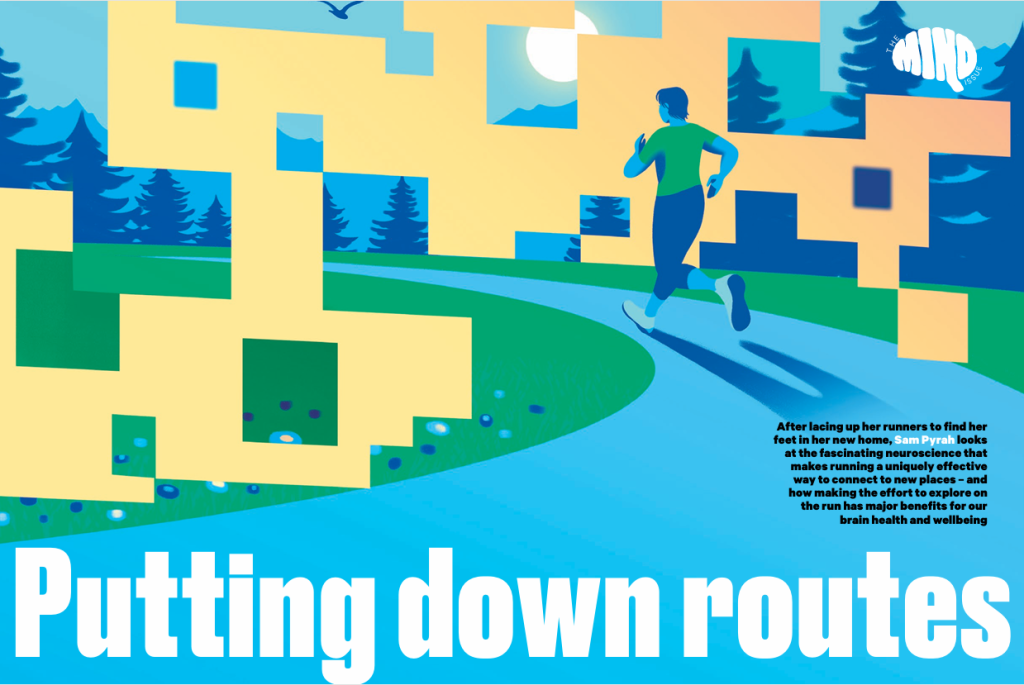
When I moved 600 miles north, from the southeast of England to the Scottish Highlands, the first thing I did once we’d unloaded the van was go for a run. It’s what I always do when I arrive somewhere new. I know of no better way to find my feet in a new place.
I set off along a track behind the house, which soon narrowed and melted into the forest. My footfall was hushed by pine needles, my breath audible in the stillness, my muscles responding to the rise and fall of the terrain. Was that water glistening between the trees? What bird was calling? Were those yellow-gold mushrooms edible? Every sense craned its neck to take it all in.
When the woods eventually spilled me out onto the road, beside a huge granny pine, I hesitated. I could retrace my steps and be home in 15 minutes. Instead, I turned left, in search of a glittering loch.
In a new place, with familiar landmarks gone, our senses come alive in a way they rarely do on tried and trusted routes. Sights, sounds and textures that usually blur into the background suddenly come into sharp focus, as we begin building a mental map of our surroundings.
You don’t need to move house to experience that ‘eyes-wide-open’ feeling of exploring somewhere new. On holiday abroad, on a weekend away – or simply by choosing the road less travelled from your own front door – running begins the process of turning an unfamiliar environment into a place we know from the ground up. As Vybarr Cregan-Reid, runner and author of Footnotes: How Running Makes Us Human, puts it: “Google Maps can tell you how a place looks, but a run tells you how it feels.”
Though it might feel instinctual, exploring somewhere new is a surprisingly complex task for the brain. “From the moment we set out to explore an unfamiliar place, the hippocampal formation – the ‘control room’ for spatial navigation and cognitive mapping – is engaged,” says Russell Epstein, professor of psychology at the University of Pennsylvania, who studies the neural mechanisms of spatial navigation.
Two types of specialist neurons, place cells and grid cells, are integral to our ability to navigate and gain a sense of place. Their discovery earned the scientists who identified them the Nobel Prize in 2014.
“Place cells, located in the hippocampus, are activated in response to familiar places – firing in a unique pattern specific to that location,” Epstein explains. “When you are somewhere unknown, ‘place fields’ for that location have yet to be developed.”
This is where grid cells come in. “Grid cells, within the entorhinal cortex, fire immediately, whether a place is known or not, forming a kind of coordinate system based on direction and distance that helps the brain map out the environment – like an inner GPS system.”
As you explore, the hippocampus combines grid cell input with sensory information to develop new patterns of activity among place cells. The next time your return, the place field pattern fires – a spark of recognition, another blank spot filled in on your mental map.
It’s part of how space becomes place: how ‘that’ fallen tree that looks like a giant fishbone becomes ‘your’ fallen tree; the landmark that tells you you’re about five minutes from home. “Our cognitive maps are never static,” says Epstein. “They are constantly changing.”
Remarkably, rodent studies suggest that place cells can begin creating location-specific firing patterns within minutes of exploring a new environment. Judging by the number of times I got lost, or emerged somewhere completely unexpected, my place cells are no match for a mouse. But gradually, the forest around my new home began to acquire shape in my mind. Landscape features I’d barely noticed on that first run – an old ruin hidden among the pines, a tree stump upholstered with moss – became landmarks to navigate by.
This landmark-recognition process is governed by the brain’s parahippocampal place area (PPA), which, Epstein explains, “seems to encode both distinct features within a landscape, say, a particular tree or building, and complete scenes – for example, a town square with a fountain at the centre.”
But, as Cregan-Reid points out, not all landmarks are visual. “When we run, we don’t just see with our eyes, but with our whole bodies,” he says. Other sensory cues – the bounce of a boardwalk beneath your feet, cobwebs brushing against your arm, the aroma of spices from a street market – can serve as anchors in a landscape.
We derive information from within, too: ‘self-motion cues’ relate to our sense of speed, incline and direction.These help us figure out where we are in relation to where we started, according to research in Imaging Neuroscience.
On one of my early runs here, I came upon an unfamiliar grassy track and decided to run it out-and-back – the surest way of not getting lost. I was well into the return leg when I began to sense that I’d been running for longer than on the way out – a self-motion cue that told me I’d passed my starting point.
I’ve often wondered what drives our compulsion to explore new places. Why do we need to know what lies around the bend, or over the hill? According to environmental psychologists Stephen and Rachel Kaplan, the desire to make sense of our environment is rooted in our evolutionary history.
For our forebears, an understanding of the landscape – and a willingness to venture into the unknown – was key to survival, and, claim the Kaplans, directly shaped the human brain’s capacity to gather, organise and recall information.
They theorised that specific aspects of an unfamiliar landscape draw us in. Two that have stood up to scientific scrutiny are mystery – essentially, the promise that there will be more to discover if you keep going – and what they described as ‘complexity’, the variety within a landscape – for example, a broadleaf woodland with a mix of trees and understorey has greater complexity than a plantation.
When viewed through an evolutionary lens, it could be that richer, more varied landscapes made a place potentially more useful to our ancestors – or it could simply be that we find such places more interesting and enjoyable to explore.
An alluring environment need not necessarily be the countryside. While the mood-boosting, stress-busting aspects of physical activity – demonstrated by improved attention and focus and better mood – are often attributed to being in green spaces, recent brain imaging research published in the journal Cities shows that any environment that is considered pleasant – including cities and other urban spaces – can activate the same pathways of rest and restoration. Beauty is in the eye of the beholder.
Sometimes when I head out for a run, it feels as if my feet are making the route-choice decisions without consulting my brain. I set off with a vague intention to run one way and suddenly find myself going another.
Following my feet in this way has led to some memorable runs. On an early morning beach run in Goa, I got to see the fishing boats coming in with their catch as the sun came up. And recently, running from a hotel just off the M6, minutes from the roar of traffic, I found myself on a country lane, the verge filled with wildflowers and the adjacent field lined with ancient beech trees. There was also the time in Portugal when I ended up at a sewage works, but uncertainty is part of the deal when you’re letting your feet lead.
Fascinatingly, recent research suggests that navigating on our own two feet recruits a specialised circuit within the occipital lobe – the brain’s visual processing centre – which appears to help us interpret the layout of the environment as we move through it. When we are in motion, but not on foot, this region, called the occipital place area (OPA), does not activate.
‘On foot’ includes walking as well as running, of course, but for me, running creates a unique dialogue between body and landscape.
It’s a conversation that grows louder when I’m not entirely sure where I am. Every twist in the path, change in gradient and landmark along the way seems to have something to tell me. I listen, but I don’t always understand.
Getting lost has always been part of my running experience. Decades ago, when I first began doing long runs, I would often set off with confidence, get hopelessly lost and have to rely on road signs and helpful strangers to find my way home. “When we are lost, we need to use sensory cues to reorient ourselves,” says Epstein. It was often stressful, but it helped me gain a sense of place – I learned where each street I passed along fitted in the puzzle. I also learned that you always find your way in the end. At 21, that felt like a useful lesson for life as well as running.
“It’s those moments of getting slightly lost and having to figure out your own way that actually show you the character of a place, be it a new city or the unmapped parts of a place you thought you knew,” says Cregan-Reid.
These days, it’s much harder to become truly lost. Most of us carry a device that can tell us exactly where we are at any given moment – and how to get home. While I can’t argue that GPS isn’t useful, we lose something when we rely on it too much. “When you follow a pre-loaded Strava map with prompts telling you where to turn, your brain is following instructions rather than navigating, and that activates it far less,” explains Faye Begeti, a neurologist and neuroscientist specialising in neurodegenerative disorders.
Cregan-Reid believes that races can put us on autopilot mode in a similar way. “When you run a race, the navigation is done for you and completely removes the need to engage with the place, its wrinkles, moles and its place markers,” he says. Travelling to Valencia to run the marathon last year brought this home to him: “I thought it would be a great way to acquaint myself with a city I didn’t know, but afterwards, despite having enjoyed the race, I realised that I remembered virtually nothing about the place. That advanced navigational technology which we all carry in our hippocampus was switched off.”
It’s worth pointing out that all running – with or without GPS – is good for your brain. Running releases brain-derived neurotrophic factor (BDNF), a chemical involved in forming, strengthening and reorganising connections between neurons. However, studies in rodents suggest that, in a new environment, running may also help the hippocampus encode spatial information more effectively.
Dr Begeti has a hunch that when we run and navigate simultaneously, without relying on GPS, the benefits may be greater than either alone. “It’s exactly the type of challenge that is useful for building what’s known as cognitive reserve, essentially extra capacity,” she says.
Research on London taxi drivers published in Hippocampus way back in 2006 provides a convincing case of the brain adapting to navigational demands. The study compared taxi drivers – who famously learn the layout of the capital’s streets through ‘The Knowledge’ – with bus drivers, who follow fixed routes, and found differences in both the volume and structure of the hippocampus.
A more recent study, published in Scientific Reports, suggests the reverse may also be true. Researchers found an association between habitual GPS use and poorer performance during self-guided navigation, with greater GPS reliance linked to a steeper decline in spatial memory over three years.
Next time you’re running somewhere new, rather than outsourcing the work to GPS, let your feet lead you. Not only is it good for your brain health, living with the uncertainty of not quite knowing what’s around the next bend – or exactly how you’ll get home – builds confidence and resilience.
There’s something else, too, that you only get from finding your own way. It brings you into the moment. That run I did on my first day here: did I once think about all those boxes to unpack, or whether we’d made the right decision to move, or how long it would take to get the wifi up and running? I did not. I was fully present every step of the way.
It’s been more than a year now since we moved. I know that forest track behind the house with every aspect of my being. I know where it gets muddy and dries in ruts that throw my balance; where I might hear crossbills calling; where to get a great view of the mountains. My mental map has expanded far beyond it, too: a whole network of capillaries branching off from that main arterial route.
I’ve noticed that as I become familiar with paths that at first felt tricky to find or follow, new ones open up to me. It’s as if the mental energy initially required to avoid getting lost has been freed up to notice other possibilities, to spot what was previously missed and seek what is not yet known.
To Epstein, this makes perfect sense: “Once you’ve encoded the main part of the route, you have a framework into which you can place more detail,” he says. “The same thing happens when you learn a new topic. At first you might feel overwhelmed by all the new concepts and terminology, but once you’ve got the basics, you can absorb more information.”
But this growing familiarity isn’t just about wayfinding. Alongside spatial navigation, the hippocampus plays a role in episodic memory: the ability to form, store and retrieve memories of things we’ve experienced, including where they happened, when they happened and who we were with. “We don’t know for sure, but there are plenty of reasons to think that place cells are involved in episodic memory,” says Epstein.
Each run leaves another layer of memory behind, until we don’t simply remember the route; we remember ourselves on it. There’s the tree root I tripped over when I ran this route for the first time with Morris. There’s the place where I met my neighbour, Fiona, running the other way and we stopped for a chat. The map stops being geographical. It becomes autobiographical.
This is part of how we build relationships with places – how we become part of a place and it becomes part of us. The memories we tread into the landscape aren’t just about place, of course. They are about people, too.
Within weeks of moving, I was standing on the start line of the local parkrun. Afterwards, I got talking to a couple from the running club. “You should come along,” they said. I did, which introduced me not only to new routes and local races, but to the beginnings of a new community. Routes began to turn into roots: no longer just lines on a map, but places imbued with memories and emotions. There’s a particular spot by the loch where I remember wondering whether I’d ever feel at home here. Now I do. I greet the granny pine and the moss-covered stump like old friends I’ve gone too long without seeing.
This heightened awareness is a gift to savour – one that is easily lost as the brain adjusts the dial, filtering out what has become familiar. The new can become old with surprising speed.
That’s why, wherever I am, if I notice myself thinking, “I wonder where that goes?”, I let my feet answer the call.
Runner’s World, November 2026